Tuesday, January 26, 2021

White-tailed Buck Encounter

 This is one method that I use in photographing wildlife. It's not for everyone, but it has worked many times for me. This is about a young White-tailed buck that I encountered many weeks ago on private property adjacent to VA Beach National Golf Course. I posted the photo earlier but this is the story behind it:

I have learned a lot about wildlife from friends and family who hunt. We have a lot in common, beginning with our mutual love of Nature and our passion about the health of the environment. My deer hunting friends recently provided me with some tips about deer behavior and how they work to "get the shot." I used this information to manage this close up portrait of a White-tailed buck.
I had been stalking this deer for a number of weeks. I knew what it liked to eat, and where and when. I found its water supply. I knew it was in a small herd, mostly does, yearlings, and at least one younger buck. All my stalking took place in my SUV, as this was in VA Beach city limits. This photo took hours of preparation and I am quite pleased with the result.
So, if you think you can "sneak up" on wildlife, you are wrong. You may encounter it with a little luck and maybe just driving by, and if you do, I hope you treasure that moment and get some nice shots. But, if you want to learn about your target/subject, I suggest you use this method. Again, I waited for a couple of hours on this day, in my SUV, for the deer herd to appear to feed or to drink. They did, and this close up of the buck is one of the results.


Tuesday, April 14, 2020

Mother Eagle

Since my childhood, I have been enamored by our national bird, the Bald Eagle.  I have memories of seeing them in several zoos and notably, Busch Gardens. I watched the local WVEC Eagle Cam  from Norfolk Botanical Gardens for many years as an adult and I grieved with thousands of people worldwide when the nesting female Eagle was killed by an incoming flight at Norfolk International Airport in 2011.
Beginning in 2018, I was fortunate to be able to watch nesting Bald Eagle pairs at several local nests in Virginia Beach as a Virginia Master Naturalist volunteer for the Virginia Bird Breeding Atlas. The most visible one is located on Honey Bee Golf Course and can be viewed from a public residential street. These Bald Eagles are perhaps the most observed Bald Eagles in Virginia, thanks to social media and local media outlets. Sadly, this nest failed in 2018 when the eggs in the nest were destroyed and the female eagle was injured by an intruding Bald Eagle, while she was incubating. The eggs were just 2 weeks away from hatching.
I was told by my Bald Eagle mentor, Reese F. Lukei, Jr. of the Center for Conservation Biology at William & Mary, that a second clutch was possible, but it didn’t happen. I watch the pair at Honey Bee for about 6 weeks following the nest failure and although the male brought in a few sticks, they did not renest and eventually left the area for a time. But, it was during this time that I was able to identify the female from the male. This particular pair is quite identical!
The following year, 2019, the nest successfully fledged its first two eaglets! It was quite exciting to be a small part of this success story! The parents were great parents! It was this season that I really was able to focus on the Bald Eagle female, who I began to privately think of as “Mother Eagle.”
I believe that Mother Eagle approves the nest location and substrate. This nest had already been built by a previous resident male Bald Eagle (banded Bald Eagle “HK”), beginning in 2013 in a very large Loblolly Pine Tree, a typical site for eagle nests in Virginia. In my opinion, he never acquired a mate at that location and eggs were never laid there. That eagle was struck and killed by an automobile in 2017, leaving the nest vacant for a new pair to claim, which they did with weeks of HK’s death.
The key to identifying male from female eagles is size. The female in the Chesapeake Bay region is typically 1/3 larger than the male. This is called reverse sexual dimorphism. Additionally, their beak depth and talon length are longer. I’ve found if they are perched side by side, it is a lot easier to tell them apart!
My observations include the male bringing in most of the nest material while the female does the “arranging.” After eggs are laid, Mother Eagle does most, but not all of the incubating. She also stays on the newly hatched eaglets for about 2 weeks after hatching, as they don’t yet have enough feathers to stay warm. The male brings in food and I have seen them both do the feeding but also occasionally she has not allowed the male to feed, even blocking him from the nest! It’s clear who is in charge and it’s Mother Eagle!

Monday, February 10, 2020

Getting Up Close and Personal to a Bald Eagle

I have been fortunate to have been able to get fairly close to Bald Eagles when photographing/observing them locally. But, these eagles have all been perched in trees or above me in another type of substrate. It is quite obvious that they are well aware of my approach as they more often than not, eventually turn and face me. My wildlife lens is on the short range of the spectrum (300mm), so when I am within 50 yards, I am feeling pretty good. It is never my intent to alter their behavior whatsoever. So, when they make this turn to look at me, I discern that I am too close and I try to back away and get into some type of cover to conclude my observation or to photograph.
However, finding a Bald Eagle on the ground and acting normally is quite exciting! Exhilarating in fact! To me, they are out of their element as generally, they are either flying, on the hunt, or perched. So, when I observed one of the nesting pair that I document at Honey Bee Golf Course in VA Beach, on the ground, very late one afternoon, I was almost giddy with excitement. The golf course had closed for the day and the weather was cold and blustery. I could see the eagle, about 400 yards away, way out of range for my 300mm lens. So, I started to walk. I met an employee putting away the golf carts and asked permission to walk to course and he waved me ahead. I had a couple of friends meeting me so I contacted them to give them my location. There would be three of us “stalking” this eagle.
The ground was pretty soggy from previous rain, but the three of us maneuvered it fairly quickly.  We crossed a small bridge across the North Landing River and soon we were in the middle of a vacant fairway. The eagle was still about 100 yards from us and across a water hazard on the course. We closed the distance to about 50 yards, the big pond still separating us and the eagle. The eagle was eating a fish at the water’s edge. By then, I am sure it either saw or sensed our presence, but it finished the meal and began hopping away from us. We froze in position. It went almost up to the golf cart path with a row of houses behind it, and began looking at pine tree branches on the ground. It “mantled” over one. Mantling means it is concealing the object (usually prey) from another bird or potential predator. After a few minutes, it made its choice, and began the flight to take its prize back to the nest. We were still snapping as the Bald Eagle flew into the sunset.
This was the closest I have ever been to a wild, healthy Bald Eagle on the ground. I guess the eagle did not perceive us three humans as a threat. We did have a lot of water between us; perhaps it understood that we could not cross that obstacle. As for us, we were so thankful to have witnessed this Bald Eagle, up close and personal. And so grateful for being able to experience it as a group. Special experiences are more special if they are shared.

Saturday, January 11, 2020

Angel Bird

The flash of white was dazzling! I was sitting by my breakfast table table window reading the Sunday paper (yes, we still subscribe) and drinking coffee. My bird feeding station is right outside this window and when I saw the flash, I glanced up and saw a dazzling white bird on the sunflower seed feeder. I knew immediately it was a rare bird, although I did not know the species immediately. The fact that it was white was the unique part. We have white birds in Virginia, but they are mainly, Egrets, Gulls, and Terns and this was obviously a songbird. I grabbed my camera on the way out the backdoor.
Of course, the white bird flew to a tree for shelter immediately. But, I possess the gift of patience and I settled into a deck chair to wait.
It was fortunately,  a short wait. A family of House Finches descended on the feeder within about 10 minutes. This is a common songbird species here. I have found them nesting in my hanging plants. House Finches generally nest in a variety of deciduous and coniferous trees. They also nest in or on buildings, using sites like vents, ledges, street lamps, ivy….and hanging planters! I watched them nonchalantly, until the white bird flew to join them. She landed on a perch and started begging the adult female House Finch for food. The female House Finch obliged and fed her!! So, that was white bird’s mother, I surmised. That made the white bird a House Finch! What a treat!!!
In about 15 minutes, the whole House Finch family was gone. I hoped they’d return but they didn’t, so I went inside to process my photos on my computer. It was then that I realized that the white bird was a leucistic bird rather than an albino. Leucistic means there is partial loss of pigmentation in an animal—which causes white, pale, or patchy coloration of the skin, hair, feathers, scales or cuticle, but not the eyes. The white bird had all white feathers but the eyes were brown, like a classic House Finch. An albino would have shown pink or red eye color.
The next day, and then the following several days, the House Finch family including the white beauty, returned to my yard to feed. I was now referring to the leucistic House Finch as the “angel bird.” It seemed only fitting. It was white, like an angel and had angel like wings. It had appeared at a time in my life when I appreciated a small miracle. I spent countless hours in my yard, observing the House Finch family and their sweet angel bird.
When they didn’t return, I was very disappointed but happy that the entire family appeared happy and healthy during the short time they spent with me. I learned a lot about the House Finch, as a species. That it itself was a priceless experience.
But, the story does not end there. Months and now years later, I am still learning that the angel bird visited other yards in the neighborhood during the time I observed her and her family. She left an indelible impression on a lot of humans during her short visit here. We can learn a lot from our feathered friends. Godspeed, Angel Bird!

Wednesday, December 11, 2019

Tundra Swans

One of the prettiest Winter visitors we have in our area is the Tundra Swan, also known as the “Whistling Swan.” Tundra Swans are very large waterfowl with heavy bodies and long necks. The adult swans are all white. The bill is mostly black and usually has a yellow spot at the base. The legs and feet are black. Immature birds are gray-tinged on the wings, head, and neck. They migrate down here from their breeding grounds in the Arctic tundra, thousands of miles.  Tundra Swans form life-long pairs that remain together year round. Migrating flocks (of up to 100 or more) are made up of family groups, a scientific fact that I find very appealing. Tundra Swans can take off easily from land or water and fly with their necks extended straight out and their black legs trailing behind. I have seen these bird families many times at Back Bay National Wildlife Refuge in VA Beach and at Mackay Island National Wildlife Refuge, just over the Virginia line in Knotts Island, NC. The thrill of seeing them never gets old. It is a true sign of Winter for me.
You can often find them mainly on shallow lakes, wide slow-moving rivers, and coastal estuaries, especially those with agricultural fields nearby. They migrate as far South as South Carolina. Destruction of southern wetlands has reduced its former food sources in wintering areas, but it has adapted by shifting its habits to feeding on waste products in agricultural fields, such as corn, soybeans, and rice. They also feed on growing winter crops such as winter wheat, rye and barley. In the Chesapeake Bay Tundra Swans use their bills and feet to root up clams from the muddy bottom. When feeding on the water Tundra Swans “tip up” like dabbling ducks to reach submerged vegetation. It’s quite comical watching a bird this size do that!
So, when you are out and about and you hear some “whistling,“ look up! It just might be a family unit of Tundra Swans!


Sunday, October 13, 2019

Southern Flying Squirrel

For several years, a small group of volunteers in the Backyard Bird Watchers and Nature Lovers  of West Neck have been monitoring several Bluebird boxes that we had installed on the Signature Golf Course. I am one of them.
We have had Bluebirds, Chickadees, House Wrens, and Tree Swallows nest successfully in these boxes. This year, we were excited to discover at the end of the summer, that two of them had Southern Flying Squirrels making a home in them.
Southern Flying Squirrels are common rodents in many parts of the country, but because they are nocturnal (active mainly at night), few people ever see them. I had never seen them in the wild until this experience!
Southern Flying Squirrels are native in Virginia. They are very, very cute! Only 8-10 inches long from nose to tail, they might more appropriately be called “gliding squirrels” because they aren’t capable of true powered flight like a bird is. Flying squirrels glide. They have a special membrane between their front and back legs that allows them to glide through the air between trees. When a flying squirrel wants to travel to another tree without touching the ground, it launches itself from a high branch and spreads out its limbs so the gliding membrane is exposed. It uses slight movements of the legs to steer, and the tail acts as a brake upon reaching its destination. Flying squirrels can cover more than 150 feet in a single glide.
When I went to check on these boxes, I carefully opened the side of the first one and cautiously peeked in. Two huge, beautiful brown eyes gazed back at me. Then the squirrel, I am guessing the female, jumped out of the entrance hole and scurried across the ground to the nearest tree, climbed up, and disappeared around the other side. I turned on my cell phone flashlight and looked back inside the box, observing at least one baby squirrel. I closed the box.
I walked over to the tree the adult squirrel had climbed and looked up, seeing nothing. I walked to the other side and there, seemingly frozen in place, was the adult flying squirrel. She was almost perfectly camouflaged and if I had not seen her relocate there I may have missed her. Southern flying squirrels have thick, soft, glossy grayish to olive brown fur with white underbellies, and I am certain it helps protect them from many predators. Their known predators include hawks, owls, domestic cats, snakes, raccoons, and foxes.
These squirrels mainly feed on nuts and acorns, especially those from hickory trees. They also eat berries, seeds, flowers, mushrooms, insects, bird eggs and dead mice. Each autumn, they may store up to 15,000 nuts to eat during winter, which they store underground or in tree cavities and crevices. We actually found where they were storing food in several of our Bluebird boxes last year!
We are so happy that they decided to make West Neck their home!

Thursday, September 12, 2019

Bald Eagle Season

The Fall and Winter seasons of each year are an exciting time for me. I call this time “Bald Eagle Season.” It is a hunting term but the description fits: It’s because this time of year, the younger Bald Eagles are either searching for a mate or the older ones are looking to reconnect with their mate from the previous nesting season. And I, as a wildlife photographer, am out “hunting” for them! They are generally very visible here locally, if you just LOOK UP!
Where? Those very high cell phone towers or high tension power line towers around our urban areas are one of their favorite perches. For some reason, they seem to enjoy meeting up in used Osprey nests. One of the most well known places are along S. Independence Blvd. and in the Kempsville area of Virginia Beach.
The Bald Eagles have outstanding 360 degree views from these perches and can see other Bald Eagles. Bald Eagles have “eagle eyes” and can easily distinguish their mate as well as other eagles that may have come into their “territory.”  Eagles use both monocular and binocular vision, meaning they can use they eyes independently or together depending on what they are looking at, and they can see great distances. I have read that an eagle can see something the size of a rabbit at more than three miles away.
When they have successfully reconnected with their mates or found a new one, nest building starts. If they are using an already established nest, the pair will begin to add sticks to it. If they are building a new one, the structure of choice locally is generally a tall, loblolly pine tree, a native tree of Virginia. Nest building intensifies in October. It is usually complete by late December, when courtship begins. The Center for Conservation Biology, a research group within The College of William and Mary and the Virginia Commonwealth University maintains a Bald Eagle nest locator: https://ccbbirds.org/maps/#eagles .
I’ve  seen courtship and mating behavior from late December through mid-January, and most local pairs have laid eggs by mid-February. Virtually all pairs in our Chesapeake  Bay region have eggs laid by the end of February.
This pre egg laying time of Bald Eagle Season can be very rewarding for both seasoned wildlife photographers and casual observers because our Bald Eagles are out and visible. I remember a time in the mid 1960’s we did not even have Bald Eagles here locally, because of the effects of the chemical DDT. They have made a fantastic rebound! When you are out and about, remember to LOOK UP!

Bald Eagles on S. Independence Blvd., VA Beach, VA.


Wednesday, August 14, 2019

Anhingas at Stumpy Lake

For the past several years, as the Principal Atlaser for a priority block of the 2nd Virginia Breeding Bird Atlas, I have been hoping to document breeding of the elusive Anhingas, here in Virginia Beach. This summer, it happened at Stumpy Lake, which is part of my priority block.
The Anhinga is an unusual looking bird with a snake like-neck and silvery feathers. They are often refereed to as the “snake bird” or the “water turkey.” The adult male is all black with silvery white feathers on his back and wings. The female and the juveniles are brown and beige. They dry their wings out of the water like our more common Double-crested Cormorants. In fact, they spend a lot of time out of the water, seeming only to go in to find a meal.  Birds of the swamps, they are right at home at Stumpy Lake, with its tannin colored water and many Bald Cypress and Tupelo trees. Stumpy Lake also has a healthy population of fish, a favorite of the Anhinga. They are considered a semi-aquatic bird, and can stay submerged for long periods. While swimming under water, Anhingas use their sharp beak and strong webbed feet to spear small fish. Anhingas thrusts are so powerful that sometimes they must come ashore and pry fish off of their beak using a rock or their feet. Like many aquatic birds, anhingas eat their food whole; tossing them in the air and swallowing fish head first so that the spines lay flat as they swallow.
Anhingas are a delight for both beginner and expert birders alike. They are easily spotted because of their unique coloration, telltale stance, and habit of staying still for long periods. Since they decided to stay visible at Stumpy Lake, they have had many visitors, so many in-fact, that they are no longer considered a “rarity” in Virginia Beach. The National Audubon Society predicts that this species will be severely impacted by climate change, and we will probably be seeing them expand their breeding range northward in the United States.
Like many migratory birds, they will head South for the winter, some all the way to South America perhaps, where many other Anhingas live and breed all year.  I pray they will return to Stumpy Lake again in 2020 to breed and raise their families. Godspeed.


Thursday, June 13, 2019

American White Pelican

We do not typically see this species of pelican in Virginia (we have the Brown Pelican) but I was fortunate to be able to spend some time in Florida with a flock spending the Winter there a few years ago. According to the National Audubon Society this is “one of the largest birds in North America, with a 9-foot wingspan. Similar to Brown Pelican in shape but much larger, and very different in habits: Occurs far inland, feeds cooperatively in shallow lakes, does not dive from the air for fish. Despite its great size, a spectacular flier, with flocks often soaring very high in the air, ponderously wheeling and circling in unison.”
I was truly amazed at the overall size of this stunning bird. Its wing span was impressive on takeoff and landing and it didn’t make a sound. But, it was watching them feed cooperatively, as a group that took my breath away. They formed a semi circle and drove their prey (fish) into shallow water where they dipped in their huge pouches and scooped them up! They take in both water and fish, and then hold their bills vertically to drain out the water before swallowing the food.It was so interesting to watch and I watched it every chance I had!
This was a very shy bird, I discovered, so the majority of photographs taken required that I actually lay on the ground or use a blind. Since every pond in Florida has at least one alligator, I needed to be on guard for that as well. And did I mention mosquitoes? Florida has them year ‘round! And this was in early April!
I look forward to spending more time with this huge bird when I venture south to Florida in Winter for warmth and sunshine. It seems we have a lot in common!


Saturday, April 13, 2019

Ruby-throated Hummingbirds

A sure sign of Spring in Virginia is the arrival of Ruby-throated Hummingbirds. This diminutive bird generally spends the winter in Central America, Mexico, and Florida, and migrates to Eastern North America for the summer to breed. It is by far the most common hummingbird seen east of the Mississippi River in North America.
I have a small garden that contains many flowering, native plants, which both hummingbirds and butterflies enjoy. I also put out one hummingbird feeder on St. Patrick’s Day (March 17th) in anticipation of their arrival.  So far, I have not yet had one that early, but with our climate changing, it’s just a matter of time. But, by mid April I begin to see an occasional male and by May the females have arrived, found a mate, and are building nests. The yard and local parks are buzzing with them!
In May, I put out two additional feeders in different parts of my yard. For the home made nectar I boil 4 cups of water, remove it from heat, add 1 cup of sugar,  stir to dissolve, and allow to cool completely. I DO NOT add red food coloring, as I have read that it can impact their health. As spring turns to summer, I change out the feeder frequently, always trying to keep it fresh.
Ruby-throats are intensely inquisitive and thus easily attracted to feeders, where males in particular typically display aggressive territoriality toward rival hummers, other birds, and even insects such as bees, butterflies, and sphinx moths. They quickly become accustomed to human presence, and will swoop down to investigate red articles of clothing, red patio umbrellas and the like, possibly looking for food.
The female Ruby-throated Hummingbird is not as brightly colored as the male but she most definitely does all the parenting. She builds the nest, incubates the eggs, feeds the hatchlings, and then feeds the fledglings for about 10 days. For a short period immediately after fledgling, a female will tolerate the presence of her own young at a feeder, but they are soon treated the same as other adult birds - as rivals in pursuit of the food necessary to prepare for the fall migration.
I see these Ruby-throated Hummingbirds  in my yard through September. You can see them too! Just buy a feeder, make some nectar, plant a few flowers or hang flowering baskets!


Saturday, March 30, 2019

Snow Geese of Pungo 2019

My husband and I have a fairly new tradition. Just after the first of the New Year, we look forward to the arrival of the Snow Geese in Pungo. It’s an annual event as thousands of these stunning white geese descend on Pungo farm fields to stock up on leftover corn, beans, and some winter wheat. They are preparing for a long flight back to their nesting grounds in the Arctic tundra of Canada and Alaska, a round trip of thousands of miles. This is truly an amazing wildlife spectacle and one that you don’t want to miss, as it happens in our own backyard! Again, these geese can number in the thousands and the sound is just glorious, especially if they take flight. This treat can last through the month of February.
The majority of the geese we see are white with black wing tips but there is also a gray form, sometimes called “Blue Goose.” Occasionally they are also mixed in with flocks of Canada Geese, but generally they stick with their own species.
How do you know where to go?
We start out on Princess Anne Road and head South, traveling to Knotts Island, if necessary. But, if you are lucky, you can encounter some flocks before that, some even right on Princess Anne Road. We have had our best luck at the intersection of Muddy Creek and Drum Point Rd., just before you make the turn into Winesett Nursery. We like late afternoon about an hour before sunset. But, there are some other hot spots including other fields on Muddy Creek Rd., Princess Anne Wildlife Management Area , Munden Rd., Morris Neck, Ships Cabin, to name a few. Just be careful about pulling over to watch as it is Pungo and well, there can be some traffic problems. If you fail on a few attempts, try the Charles Kuralt Trail overlook on Mackay Island National Wildlife Refuge, just over the state line in North Carolina. Park at the overlook and look across the road to the water. The Snow Geese may be foraging there.We have also seen them up by the Back Bay Post Office and in the field by the Sandbridge Harris Teeter. We hope you get lucky like we have! It is truly an unforgettable sight!

Wednesday, March 13, 2019

The Prothonotary Warbler

One sign of Spring for me is the appearance of the Prothonotary Warblers at Stumpy Lake. Stumpy Lake is one of my favorite places for birds locally.  In Spring, these brilliant yellow birds appear and delight many local birders and photographers.  These birds are conspicuous, and their loud ringing song can help guide you to them even before you see them. The best times to look for them in the U.S. are from April–July. They generally appear in forested wetlands  and swamps, so Stumpy Lake provides ideal habitat. It’s one of two warblers that nest in tree cavities, so I take dozens of hikes, peering into these cavities in search of them.
The Prothonotary Warbler got its name from the bright yellow robes worn by papal clerks, known as prothonotaries, in the Roman Catholic church.
I have had three interesting experiences with this bird. When I first started birding, my mentor played a recording of the Prothonotary at Stumpy Lake early in the migration season.  A male appeared within about 2 minutes and we were treated to a great look at him for maybe 30 seconds, but enough time to snap a quick photo. The second time, I was stopped in my car at the North Landing River for a drawbridge opening. It was a pretty Spring morning and I had the windows down in my SUV. I had a birding app on my cell phone, and on a whim, I played the male Prothonotary song. Almost immediately, a male Prothonotary appeared in a lower tree branch right next to my vehicle. I thought he was going to land on my lap!!! Thankfully, the bridge traffic started moving again! It was disturbing enough of an experience, that it caused me to rethink the ethics of using a recording to lure in a bird.
The third time, involved the bird pictured. It was early April of 2018 at Stumpy Lake. I was there specifically for this pretty bird because I had a new wildlife lens that I wanted to photograph it with. I knew where a pair was building a nest, so I waited several minutes to see if one would appear. I could also hear one in the distance. I don’t like to stand by an active nest too long, so I decided to follow the sound of the one I could hear. I walked down the causeway entry road. The singing got louder. The male has a loud, far-carrying song of 4–14 high-pitched ringing notes, sometimes likened to shouting “tweet-tweet-tweet-tweet.” Each note is slightly up-slurred and the series of notes increases in volume at the end. He frequently sings from elevated perches especially early in the morning, singing about 5–6 songs per minute. Once you know it, you will recognize it, always.  It’s a sweet song.
I was almost on top of the bird when I saw it. It was perched on an very large stump. The mouth was wide open, and it was singing its heart out. I touched the shutter and the camera clicked off a series of photos in rapid succession. That was enough of a noise for the Prothonotary….it immediately took flight into the thick woods. What a beautiful moment in time! I stood there, in quiet joy.


Wednesday, February 13, 2019

Eastern Meadowlark

The Eastern Meadowlark is a gorgeous bird that lives in farm fields, grasslands, and wet fields, according to bird guide books. Locally, however, I have found them in larger school yards, soccer fields, and vacant lots.  They have been a nemesis of sorts for me the last several years, as I have tried and failed to obtain a closeup photo of one.  That changed recently when I made a trip to Tractor Supply in Virginia Beach to replenish bird seed for my bird feeders.
As I walked through the parking lot, I heard the unmistakable song of an Eastern Meadowlark, a clear, mellow whistle.  I found the source immediately, the gorgeous bird perched on a sign, singing its heart out. With several bags of birdseed in my arms, I hurried to my car to get my camera.
Of course, by the time I got to the car, unloaded the seed, and grabbed my camera, the Meadowlark was nowhere to be seen. But, I knew it was there!
So, I moved the car closer to the vacant lot where I had seen it, and waited. And waited.
And waited. And waited some more.
Finally, I saw some movement. Eastern Meadowlarks walk on the ground, often concealed by grasses or other vegetation.  In winter you may see flocks of meadowlarks hunting insects in fields. They can be quite difficult to see as they use their coloring to their advantage. Although they are mostly brown and black, they have bright-yellow underparts and a bold black V across the chest. Truly stunning!
I was now using my car as a blind. Suddenly, an Eastern Meadowlark’s head popped up, right next to me! I snapped the shutter and held it down for about a dozen quick shots.
That’s all I got as the Meadowlark was now spooked and flew across the road. I was pretty sure there were others. So I waited, once again.
Fifteen minutes later, the hidden flock began to move, but unfortunately, away from my location. I counted just 7 more.
I was indeed fortunate to obtain those first dozen shots and although my time with these birds was very short, it was an experience I will treasure! A nemesis no longer!

Tuesday, January 8, 2019

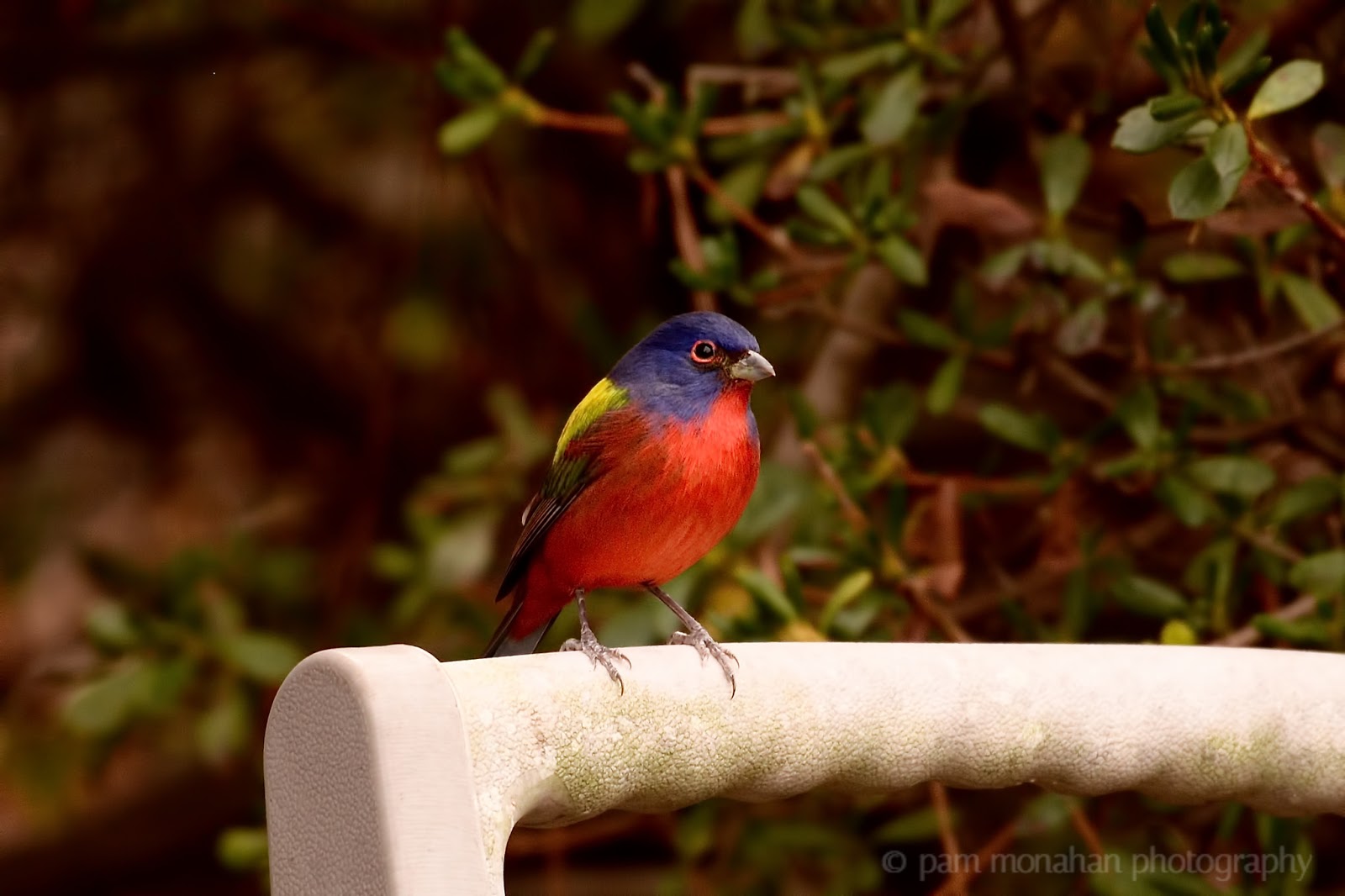
The Painted Bunting - A Trophy Bird

I am a trophy hunter. Although my weapon is not a gun, it is a sophisticated digital camera with a long, sharp, powerful lens. I don’t care for the word “hunt,” but that is what I am doing, as I patiently stalk birds or animals or sit for hours awaiting their appearance. I actually own a hunting blind but generally I use my Honda Pilot for that purpose. I dress in hunter camo clothes, when I am in the field, purchased in the hunting/fishing section of local retailers.
The trophy I was after to begin the New Year of 2019 was a songbird; the beautiful Painted Bunting.
The male bunting wears a coat of many colors. Male Painted Buntings are so stunning that they have been called "nonpareils," which means “having no equal” in French. The female is a beauty also, one of the few bright green birds in the wild.
Despite the male’s brilliant plumage, Painted Buntings can be hard to find. Their range is more limited than those of other buntings. They are shy birds that prefer thickets and brushy cover. Painted Buntings are a bird of the South, breeding from coastal North Carolina to northern Florida. They migrate at night and usually spend the winter in Florida and the northern Caribbean. So, when they show up in Virginia during winter, it is most unusual but a very exciting event. Sightings are so rare that the locations are not always shared as local birders, bird enthusiasts, and bird photographers are known to flock to these locations just to catch a glimpse of or to photograph these rare visitors.
I did actually have the opportunity to photograph some Painted Buntings at a local residence in VA Beach in 2018. That location was confidentially shared with me and I was able to return there again this year. But, I also did some detective work and found a second local private residence where the buntings were visiting this winter. This visit turned out to be very special as I was able to share it with a good friend and neighbor. Plus, it turned out that I had previously met the property owner!
It was cold and breezy when my friend and I arrived in Chesapeake that first week of January.  I was dressed in camo, of course. She needed an extra layer so I loaned her an extra jacket, camo, naturally! We looked the part of hunters; 2 silver haired ladies, one armed with binoculars and one with a big camera with a long lens! We sat down in a couple of porch chairs and waited for our “prey.”
It took over an hour in frigid temperatures but the magnificent bird suddenly appeared before us! Good thing we didn’t blink, or we would have missed it! We had about 25 seconds with it, then it vanished in the dense shrubs. We were cold but so happy! For we had been treated to the rare sight of the gorgeous Painted Bunting and I had a dozen photos to prove it: trophy shots? They may have been at the time, but now I just want to spread the great news that this special bird has chosen Hampton Roads to spend some time. And I thank these local caretakers of these amazing birds for allowing me and my friend the opportunity to spend just a few minutes with them.


Sunday, November 11, 2018

The Christmas Owl

It had been a long, but joyous Christmas Eve. We had a sumptuous Holiday dinner with friends and family, followed by a beautiful Midnight Mass at our church. My husband and I were tired but happy and had just tucked ourselves into our warm winter bed when there was a scurry of something in our bedroom fireplace! “Reindeer,” I giggled. He chuckled. But, I grabbed a flashlight and got up to investigate. 
I had to practically lay on the floor to see up into the chimney. It was very dark but I could hear the wind howling. Or was that the wind?  “Quiet, please, “ I whispered. I heard it again. “There’s an animal in here,” I hissed.
“In the fireplace?” he asked, incredulously.
“I think it’s on a shelf thingy,” I answered. “Go get some crackers and peanut butter so we can get it to come down. We’ll catch it then get it out. It’s probably a squirrel.”  I pulled the chain fireplace screen closed.
So, we set out the bait and tried to sleep. We must have drifted off when suddenly we heard a fluttering. I crept across to the fireplace with the flashlight and peeked in. Two huge eyes stared back at me. “It’s an owl!” I hooted.
“Oh geesh,” my husband replied.
We removed the window screens and opened all our bedroom windows. I carefully pulled back the fireplace screen and tried and missed the little owl with a towel. It flew erratically around our bedroom. It tried to land on the curtain rods and flew into the bedroom mirror. It fell onto my jewelry box. My husband tossed the towel and it settled over the owl. “What do we do now?” he asked.
“Take it to the window and let it go,” I replied.
“My God!” exclaimed my husband. “It weighs almost nothing.”
“Just be careful,” I said.
He gently removed the towel and the tiny owl flew silently into that dark Christmas morning. It was an Eastern Screech-Owl, a species that we had heard many times on our property and had in fact called it in close, on occasion.
But, this story doesn’t end there.
That Christmas night, after we had the kids in bed, we stepped outside on our deck. Just above us in a tree we heard the unmistakeable call of an Eastern Screech-Owl. It was calling to thank us or perhaps to say, “Merry Christmas to and to all a good night!”

Note: The Eastern Screech-Owl pictured is not the same owl featured in this story. This is “Lola,” an educational ambassador at First Landing State Park.

Wednesday, October 10, 2018

The Belted Kingfisher

Locals to this area have probably already heard this bird, just didn’t know what it was. It emits a piecing “rattle” call as it patrols over lakes and ponds. It is also one of the few bird species where the female has more attractive coloring than the male. The Belted Kingfisher pictured here is a female, who sports a blue belt (as does the male) across the chest, but also a bright chestnut band. She’s a beauty!
Belted Kingfishers are stocky, large-headed birds with a shaggy crest on the top and back of the head and a straight, thick, pointed bill. Their legs are short and their tails are medium length and square-tipped. They are about the size of a Robin.
The Belted Kingfisher nests in burrows along earthen banks. They generally choose a bank near water, but may use a ditch, road cut, landfill, sand pit, or gravel pit far from water.  A pair may select a nest site during courtship, usually high in the bank where floodwaters are unlikely to reach. The male probes the bank with his bill, flying back and forth to the female, who calls continuously from a nearby perch.The male and the female take turns digging the burrow, with males spending about twice as much time digging as females. They can have 1 or 2 broods a nesting season.
The Belted Kingfisher feeds almost entirely on aquatic prey, diving to catch fish and crayfish with its heavy, straight bill. I’ve seen it catch fish hovering on the fly but also dropping down from a perched location. When it spots a fish or crayfish near the surface, it takes flight, dives with closed eyes, and grabs the prey in its bill with a pincer motion. Returning with its prize, it pounds the prey against the perch before swallowing it head first. GULP!
Compared to other fish-eating birds, Belted Kingfishers seem to be relatively unaffected by environmental contaminants, possibly because their small prey accumulates only low levels of toxins. Kingfisher populations are limited by the number of earthen banks available for nesting, and some populations have grown and spread thanks to human-made sand and gravel pits. They are sensitive to disturbance, and may abandon territories if people begin frequenting the area.
So, the next time you hear that unmistakable rattle and maybe see a flash of blue; it’s a Belted Kingfisher!

Monday, September 17, 2018

The Marbled Godwit

The Marbled Godwit is a special bird I learned to love during my time as a winter Florida resident. They like to come to Florida for the winter also! When I heard that one had been observed on the beach at Back Bay National Wildlife Refuge in August, I had to see if I could locate this big, beautiful bird!
Their breeding habitat is the northern prairies of western Canada (Canadian Prairies), and the north central Great Plains of the United States near marshes or ponds. So, this large shore bird had come a very long way to land in southeast Virginia.
It was pretty hot that day in August. I arrived at the Refuge about 10AM and hit the beach armed with my camera, beach chair, and water. I was prepared to walk a mile or more in the hopes of finding this bird. As I completed the hike down the boardwalk and hit the sandy  beach, I could already see some shorebirds and a number of fishermen.
I set up my chair and sat down. The beautiful, Atlantic Ocean was stretched as far as the eye could see, right in front of me. And also, unbelievably, was the Marbled Godwit!
I could not believe my luck! Next to the Godwit was a Willet, another rather large shorebird, very common in Virginia Beach. But there the similarity ends. The Marbled Godwit is an extra large bird with striking cinnamon colors. The long, slightly upturned, two toned swordlike bill is most impressive, as it plunges it deep into sand or mud to pull out aquatic invertebrates and plant tubers. I sat there, stunned.
But I quickly regained my composure and started shooting. More Willets flew in to join the buffet and also some tiny Sanderlings. Breakfast must be good!
The birds kept me entertained for about 45 minutes. But eventually they followed whatever they were dining on further down the beach and more fishermen appeared to also enjoy the ocean’s bounty that morning. I packed up my gear and headed to the parking lot, a smile on my face.
The Marbled Godwit is considered to be “climate endangered.”  Its numbers were reduced by market hunting during the 19th century. There has been some recovery since, but the bird is now declining again as more and more of its nesting habitat is converted to farmland.


Thursday, August 16, 2018

A Green Heron Nest

The Green Heron is an elusive bird and I guess it is for that reason that I really enjoy them when encountered. This small heron is solitary at most seasons and often somewhat secretive, living around small bodies of water or densely vegetated areas. Seen in the open, it often flicks its tail nervously, raises and lowers its crest. The "green" on this bird's back is an iridescent color, and often looks dull bluish or simply dark. It is a beautiful bird.
So, when I found the nest of this species, it was truly special for me. Green Heron nests are notoriously difficult to find. The nest site is usually in shrub or tree 5-30' above ground, but sometimes on ground; often very close to water but can be quite distant. The nest is a platform of sticks; the male begins construction, then female builds while male brings materials. This particular nest was in a mimosa tree, over a small, local pond in a residential neighborhood.
When I found the nest, it was already complete. One of the pair appeared to be incubating eggs or perhaps brooding chicks. It rose nervously at my approach, so I stopped and froze in place. It settled back down on the nest. I retreated back a few steps and got behind a tree to take a few photos. A second heron came in with a stick and the one on the nest accepted it and placed it. How sweet! I left.
It was another week before I returned.
When I got back, the babies were scrunched down in the nest. Neither parent was visible, so I slowly edged closer with my camera. Young baby birds have generally not yet developed a fear of humans, but I am careful anyway. I stopped suddenly when I heard an adult’s loud, unmistakable call: “SKEOW!” The heron landed almost directly above me and called to the chicks, “cuk, cuk.” The chicks recognized their parent and started begging, “tik, tik, tik, tik.” They stood up and I counted four of them.  I raised my camera. The adult landed beside the nest and it was just a mass of feathers and curious sounds as the chicks were fed.
It was over in about 30 seconds. The adult flew and the chicks immediately settled down into the nest. There was such a mass of branches and leaves obscuring the view that I only got a couple of photos of this incredible experience. But I will treasure them.
I am happy to report that all four of these Green Heron chicks successfully fledged the nest and are now on their own. They will be heading South for the winter, as do many migratory birds. Godspeed.

Friday, June 22, 2018

My friend, the Eastern Cottontail

The eastern cottontail rabbit is the rabbit most commonly seen in my neighborhood. And why not? It seems like the perfect place for them as they love living on the fringe of open spaces…like our golf course! And they adapt easily to residential yards and gardens. I’ve seen many of them hopping away from me, showing their cotton like tail, for which they are aptly named.
Usually seen at dusk and dawn, I was surprised when I started seeing one appear in my yard during daylight hours. One morning I saw 2 very large rabbits cavorting on the golf course! It wouldn’t be long before there would be baby bunnies, I mused.
I was right! Several weeks later, my landscaper discovered a group of 4 of them in a shallow ground nest, lined with the mother’s own fur, in a front yard flower bed. They were pretty old by then as their eyes were open and they were not happy about being discovered. We covered them up, and I waited for them to leave.
The mother continued to visit my garden during the day. The female eastern cottontail generally only nurses her young at dawn and dusk. But, she is always nearby, and keeps an eye on things. If you find a nest of baby rabbits, don’t assume they are orphans. Chances are, the mom is watching you!
There are typically 3-6 young in each litter. The baby rabbits develop quickly and are weaned and independent at 2-3 weeks of age, if they survive. Nest success is usually low. Only about one half of cottontails will survive long enough to leave the nest. Another half of those that leave the nest will perish before fall. The main causes of nest failure are predation and flooding.
But, the eastern cottontail is a very prolific species. High reproductive effort is needed to offset its low survival rate and low reproductive success. Females will usually mate and become pregnant immediately after giving birth. They may have 3-7 litters in a year. One male and one female eastern cottontail could multiply into 25 rabbits in less than a year! (Info from the VA Department of Game & Inland Fisheries)
After I week, when I didn’t see the female for 2 days, I checked the nest and it was empty. I saw a baby bunny scurry to cover in the shrubs of my next door neighbor’s yard. Good luck, little one, I prayed.
Yet, the rabbit story continues. I am certain that she has another nest close by as she still is visiting my garden and having a daily feast of herbs and flowers. She also enjoys a nice dessert of wild clover, courtesy of the golf course. I can usually count on seeing her everyday and she has given me dozens of photo opportunities and glimpses into her wild life. I will never forget my friend, the eastern cottontail.


Tuesday, March 20, 2018

The Snow Geese of Pungo

One of my favorite experiences of living in Pungo is the annual appearance of migrating Snow Geese. These beautiful geese are generally visible in February and early March in Pungo farm fields as they make their way back to the Arctic tundra to breed, thus completing a round trip of thousands of miles! This annual migration of Snow Geese has been called one of the greatest wildlife spectacles in North America. And we are so very fortunate to be able to witness a small part of it. With that in mind, when I speak of the Snow Geese that appear here, I am talking about flocks numbering in the hundreds and sometimes thousands. They are very vocal and can often be heard from more than a mile away. You may have actually heard them flying overhead!
The Snow Goose has two color plumage morphs, white (snow) or gray/blue (blue), thus the common description as "snows" and "blues". White-morph birds are white except for black wing tips, and this is what we generally see here. Blue-morph geese have bluish-grey plumage replacing the white except on the head, neck and tail tip. The immature blue phase is drab or slate-gray with little to no white on the head, neck, or belly. Both snow and blue phases have rose-red feet and legs, and pink bills with black tomia ("cutting edges"), giving them a black "grin patch". The colors are not as bright on the feet, legs, and bill of immature birds. The head can be stained rusty-brown from minerals in the soil where they feed.
When the Snow Geese are in Pungo farm fields, they seem to be feeding on left over grain, wheat, or resting in preparation for their long trip back to the Arctic tundra. My experience is that I see them in the daylight hours, as they spend in night floating in water, probably in Back Bay or at Mackay Island National Wildlife Refuge just over the line in North Carolina. If they are threatened by a predator, such as a hawk, Bald Eagle, or coyote, they will immediately take flight, and that is truly an amazing sight as they all take off together, as if on cue. And the sound is not something you will soon forget.
Snow Geese nest and breed in the Arctic tundra in the Spring and it is believed that they mate for life. The females return to the place that they were hatched to breed. She selects the location and builds the nest. Both parents protect the young and they can feed themselves after hatching. But they remain with their family until they are 2 to 3 years old. So, there are usually many family units in our Pungo fields.
I urge you take take a leisurely drive in Pungo next February or March. In the meantime, there are many videos online of the migration. Watch some! You will be amazed!