Wednesday, February 13, 2019

Eastern Meadowlark

The Eastern Meadowlark is a gorgeous bird that lives in farm fields, grasslands, and wet fields, according to bird guide books. Locally, however, I have found them in larger school yards, soccer fields, and vacant lots.  They have been a nemesis of sorts for me the last several years, as I have tried and failed to obtain a closeup photo of one.  That changed recently when I made a trip to Tractor Supply in Virginia Beach to replenish bird seed for my bird feeders.
As I walked through the parking lot, I heard the unmistakable song of an Eastern Meadowlark, a clear, mellow whistle.  I found the source immediately, the gorgeous bird perched on a sign, singing its heart out. With several bags of birdseed in my arms, I hurried to my car to get my camera.
Of course, by the time I got to the car, unloaded the seed, and grabbed my camera, the Meadowlark was nowhere to be seen. But, I knew it was there!
So, I moved the car closer to the vacant lot where I had seen it, and waited. And waited.
And waited. And waited some more.
Finally, I saw some movement. Eastern Meadowlarks walk on the ground, often concealed by grasses or other vegetation.  In winter you may see flocks of meadowlarks hunting insects in fields. They can be quite difficult to see as they use their coloring to their advantage. Although they are mostly brown and black, they have bright-yellow underparts and a bold black V across the chest. Truly stunning!
I was now using my car as a blind. Suddenly, an Eastern Meadowlark’s head popped up, right next to me! I snapped the shutter and held it down for about a dozen quick shots.
That’s all I got as the Meadowlark was now spooked and flew across the road. I was pretty sure there were others. So I waited, once again.
Fifteen minutes later, the hidden flock began to move, but unfortunately, away from my location. I counted just 7 more.
I was indeed fortunate to obtain those first dozen shots and although my time with these birds was very short, it was an experience I will treasure! A nemesis no longer!

Tuesday, January 8, 2019

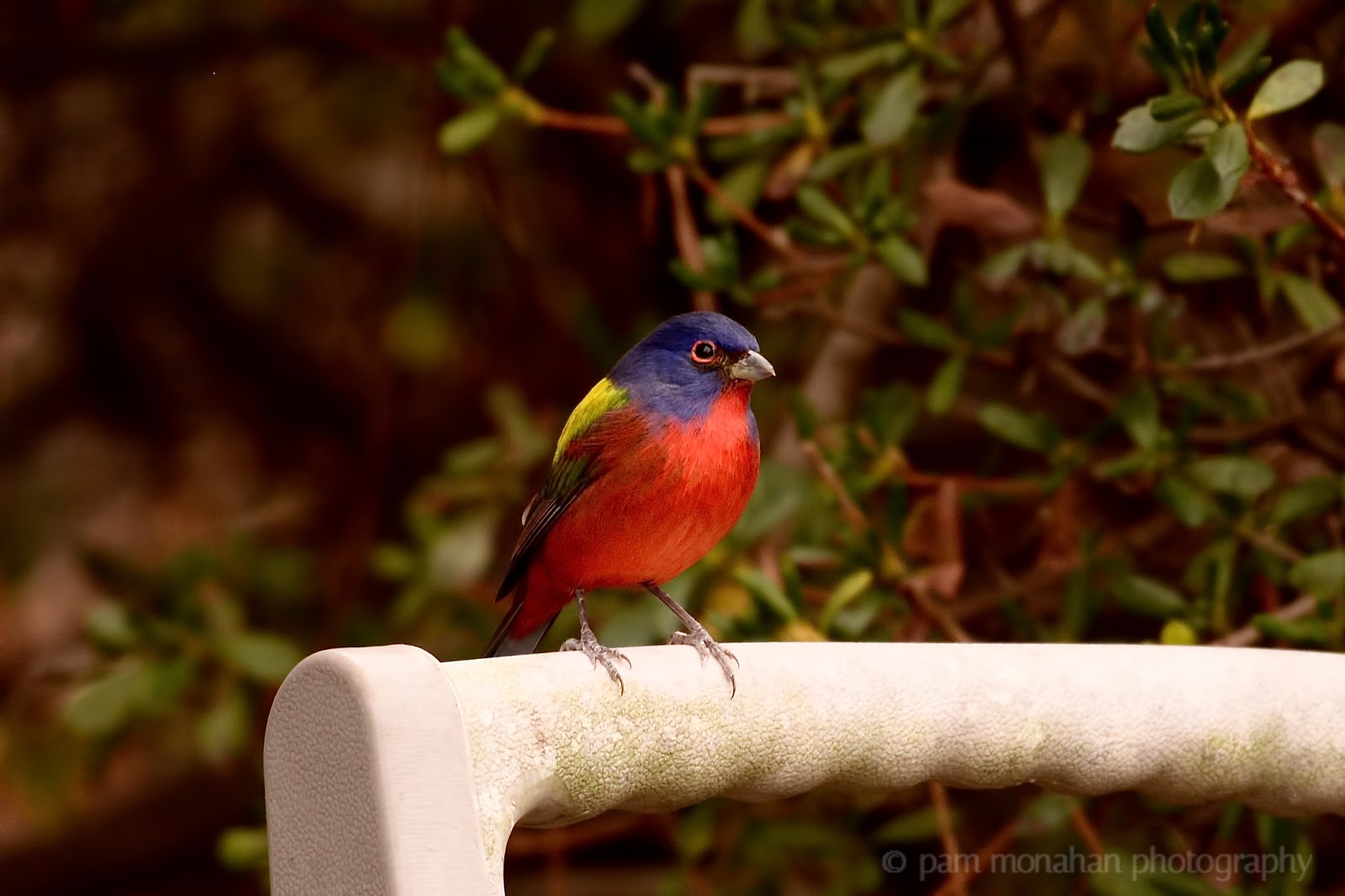
The Painted Bunting - A Trophy Bird

I am a trophy hunter. Although my weapon is not a gun, it is a sophisticated digital camera with a long, sharp, powerful lens. I don’t care for the word “hunt,” but that is what I am doing, as I patiently stalk birds or animals or sit for hours awaiting their appearance. I actually own a hunting blind but generally I use my Honda Pilot for that purpose. I dress in hunter camo clothes, when I am in the field, purchased in the hunting/fishing section of local retailers.
The trophy I was after to begin the New Year of 2019 was a songbird; the beautiful Painted Bunting.
The male bunting wears a coat of many colors. Male Painted Buntings are so stunning that they have been called "nonpareils," which means “having no equal” in French. The female is a beauty also, one of the few bright green birds in the wild.
Despite the male’s brilliant plumage, Painted Buntings can be hard to find. Their range is more limited than those of other buntings. They are shy birds that prefer thickets and brushy cover. Painted Buntings are a bird of the South, breeding from coastal North Carolina to northern Florida. They migrate at night and usually spend the winter in Florida and the northern Caribbean. So, when they show up in Virginia during winter, it is most unusual but a very exciting event. Sightings are so rare that the locations are not always shared as local birders, bird enthusiasts, and bird photographers are known to flock to these locations just to catch a glimpse of or to photograph these rare visitors.
I did actually have the opportunity to photograph some Painted Buntings at a local residence in VA Beach in 2018. That location was confidentially shared with me and I was able to return there again this year. But, I also did some detective work and found a second local private residence where the buntings were visiting this winter. This visit turned out to be very special as I was able to share it with a good friend and neighbor. Plus, it turned out that I had previously met the property owner!
It was cold and breezy when my friend and I arrived in Chesapeake that first week of January.  I was dressed in camo, of course. She needed an extra layer so I loaned her an extra jacket, camo, naturally! We looked the part of hunters; 2 silver haired ladies, one armed with binoculars and one with a big camera with a long lens! We sat down in a couple of porch chairs and waited for our “prey.”
It took over an hour in frigid temperatures but the magnificent bird suddenly appeared before us! Good thing we didn’t blink, or we would have missed it! We had about 25 seconds with it, then it vanished in the dense shrubs. We were cold but so happy! For we had been treated to the rare sight of the gorgeous Painted Bunting and I had a dozen photos to prove it: trophy shots? They may have been at the time, but now I just want to spread the great news that this special bird has chosen Hampton Roads to spend some time. And I thank these local caretakers of these amazing birds for allowing me and my friend the opportunity to spend just a few minutes with them.


Sunday, November 11, 2018

The Christmas Owl

It had been a long, but joyous Christmas Eve. We had a sumptuous Holiday dinner with friends and family, followed by a beautiful Midnight Mass at our church. My husband and I were tired but happy and had just tucked ourselves into our warm winter bed when there was a scurry of something in our bedroom fireplace! “Reindeer,” I giggled. He chuckled. But, I grabbed a flashlight and got up to investigate. 
I had to practically lay on the floor to see up into the chimney. It was very dark but I could hear the wind howling. Or was that the wind?  “Quiet, please, “ I whispered. I heard it again. “There’s an animal in here,” I hissed.
“In the fireplace?” he asked, incredulously.
“I think it’s on a shelf thingy,” I answered. “Go get some crackers and peanut butter so we can get it to come down. We’ll catch it then get it out. It’s probably a squirrel.”  I pulled the chain fireplace screen closed.
So, we set out the bait and tried to sleep. We must have drifted off when suddenly we heard a fluttering. I crept across to the fireplace with the flashlight and peeked in. Two huge eyes stared back at me. “It’s an owl!” I hooted.
“Oh geesh,” my husband replied.
We removed the window screens and opened all our bedroom windows. I carefully pulled back the fireplace screen and tried and missed the little owl with a towel. It flew erratically around our bedroom. It tried to land on the curtain rods and flew into the bedroom mirror. It fell onto my jewelry box. My husband tossed the towel and it settled over the owl. “What do we do now?” he asked.
“Take it to the window and let it go,” I replied.
“My God!” exclaimed my husband. “It weighs almost nothing.”
“Just be careful,” I said.
He gently removed the towel and the tiny owl flew silently into that dark Christmas morning. It was an Eastern Screech-Owl, a species that we had heard many times on our property and had in fact called it in close, on occasion.
But, this story doesn’t end there.
That Christmas night, after we had the kids in bed, we stepped outside on our deck. Just above us in a tree we heard the unmistakeable call of an Eastern Screech-Owl. It was calling to thank us or perhaps to say, “Merry Christmas to and to all a good night!”

Note: The Eastern Screech-Owl pictured is not the same owl featured in this story. This is “Lola,” an educational ambassador at First Landing State Park.

Wednesday, October 10, 2018

The Belted Kingfisher

Locals to this area have probably already heard this bird, just didn’t know what it was. It emits a piecing “rattle” call as it patrols over lakes and ponds. It is also one of the few bird species where the female has more attractive coloring than the male. The Belted Kingfisher pictured here is a female, who sports a blue belt (as does the male) across the chest, but also a bright chestnut band. She’s a beauty!
Belted Kingfishers are stocky, large-headed birds with a shaggy crest on the top and back of the head and a straight, thick, pointed bill. Their legs are short and their tails are medium length and square-tipped. They are about the size of a Robin.
The Belted Kingfisher nests in burrows along earthen banks. They generally choose a bank near water, but may use a ditch, road cut, landfill, sand pit, or gravel pit far from water.  A pair may select a nest site during courtship, usually high in the bank where floodwaters are unlikely to reach. The male probes the bank with his bill, flying back and forth to the female, who calls continuously from a nearby perch.The male and the female take turns digging the burrow, with males spending about twice as much time digging as females. They can have 1 or 2 broods a nesting season.
The Belted Kingfisher feeds almost entirely on aquatic prey, diving to catch fish and crayfish with its heavy, straight bill. I’ve seen it catch fish hovering on the fly but also dropping down from a perched location. When it spots a fish or crayfish near the surface, it takes flight, dives with closed eyes, and grabs the prey in its bill with a pincer motion. Returning with its prize, it pounds the prey against the perch before swallowing it head first. GULP!
Compared to other fish-eating birds, Belted Kingfishers seem to be relatively unaffected by environmental contaminants, possibly because their small prey accumulates only low levels of toxins. Kingfisher populations are limited by the number of earthen banks available for nesting, and some populations have grown and spread thanks to human-made sand and gravel pits. They are sensitive to disturbance, and may abandon territories if people begin frequenting the area.
So, the next time you hear that unmistakable rattle and maybe see a flash of blue; it’s a Belted Kingfisher!

Monday, September 17, 2018

The Marbled Godwit

The Marbled Godwit is a special bird I learned to love during my time as a winter Florida resident. They like to come to Florida for the winter also! When I heard that one had been observed on the beach at Back Bay National Wildlife Refuge in August, I had to see if I could locate this big, beautiful bird!
Their breeding habitat is the northern prairies of western Canada (Canadian Prairies), and the north central Great Plains of the United States near marshes or ponds. So, this large shore bird had come a very long way to land in southeast Virginia.
It was pretty hot that day in August. I arrived at the Refuge about 10AM and hit the beach armed with my camera, beach chair, and water. I was prepared to walk a mile or more in the hopes of finding this bird. As I completed the hike down the boardwalk and hit the sandy  beach, I could already see some shorebirds and a number of fishermen.
I set up my chair and sat down. The beautiful, Atlantic Ocean was stretched as far as the eye could see, right in front of me. And also, unbelievably, was the Marbled Godwit!
I could not believe my luck! Next to the Godwit was a Willet, another rather large shorebird, very common in Virginia Beach. But there the similarity ends. The Marbled Godwit is an extra large bird with striking cinnamon colors. The long, slightly upturned, two toned swordlike bill is most impressive, as it plunges it deep into sand or mud to pull out aquatic invertebrates and plant tubers. I sat there, stunned.
But I quickly regained my composure and started shooting. More Willets flew in to join the buffet and also some tiny Sanderlings. Breakfast must be good!
The birds kept me entertained for about 45 minutes. But eventually they followed whatever they were dining on further down the beach and more fishermen appeared to also enjoy the ocean’s bounty that morning. I packed up my gear and headed to the parking lot, a smile on my face.
The Marbled Godwit is considered to be “climate endangered.”  Its numbers were reduced by market hunting during the 19th century. There has been some recovery since, but the bird is now declining again as more and more of its nesting habitat is converted to farmland.


Thursday, August 16, 2018

A Green Heron Nest

The Green Heron is an elusive bird and I guess it is for that reason that I really enjoy them when encountered. This small heron is solitary at most seasons and often somewhat secretive, living around small bodies of water or densely vegetated areas. Seen in the open, it often flicks its tail nervously, raises and lowers its crest. The "green" on this bird's back is an iridescent color, and often looks dull bluish or simply dark. It is a beautiful bird.
So, when I found the nest of this species, it was truly special for me. Green Heron nests are notoriously difficult to find. The nest site is usually in shrub or tree 5-30' above ground, but sometimes on ground; often very close to water but can be quite distant. The nest is a platform of sticks; the male begins construction, then female builds while male brings materials. This particular nest was in a mimosa tree, over a small, local pond in a residential neighborhood.
When I found the nest, it was already complete. One of the pair appeared to be incubating eggs or perhaps brooding chicks. It rose nervously at my approach, so I stopped and froze in place. It settled back down on the nest. I retreated back a few steps and got behind a tree to take a few photos. A second heron came in with a stick and the one on the nest accepted it and placed it. How sweet! I left.
It was another week before I returned.
When I got back, the babies were scrunched down in the nest. Neither parent was visible, so I slowly edged closer with my camera. Young baby birds have generally not yet developed a fear of humans, but I am careful anyway. I stopped suddenly when I heard an adult’s loud, unmistakable call: “SKEOW!” The heron landed almost directly above me and called to the chicks, “cuk, cuk.” The chicks recognized their parent and started begging, “tik, tik, tik, tik.” They stood up and I counted four of them.  I raised my camera. The adult landed beside the nest and it was just a mass of feathers and curious sounds as the chicks were fed.
It was over in about 30 seconds. The adult flew and the chicks immediately settled down into the nest. There was such a mass of branches and leaves obscuring the view that I only got a couple of photos of this incredible experience. But I will treasure them.
I am happy to report that all four of these Green Heron chicks successfully fledged the nest and are now on their own. They will be heading South for the winter, as do many migratory birds. Godspeed.

Friday, June 22, 2018

My friend, the Eastern Cottontail

The eastern cottontail rabbit is the rabbit most commonly seen in my neighborhood. And why not? It seems like the perfect place for them as they love living on the fringe of open spaces…like our golf course! And they adapt easily to residential yards and gardens. I’ve seen many of them hopping away from me, showing their cotton like tail, for which they are aptly named.
Usually seen at dusk and dawn, I was surprised when I started seeing one appear in my yard during daylight hours. One morning I saw 2 very large rabbits cavorting on the golf course! It wouldn’t be long before there would be baby bunnies, I mused.
I was right! Several weeks later, my landscaper discovered a group of 4 of them in a shallow ground nest, lined with the mother’s own fur, in a front yard flower bed. They were pretty old by then as their eyes were open and they were not happy about being discovered. We covered them up, and I waited for them to leave.
The mother continued to visit my garden during the day. The female eastern cottontail generally only nurses her young at dawn and dusk. But, she is always nearby, and keeps an eye on things. If you find a nest of baby rabbits, don’t assume they are orphans. Chances are, the mom is watching you!
There are typically 3-6 young in each litter. The baby rabbits develop quickly and are weaned and independent at 2-3 weeks of age, if they survive. Nest success is usually low. Only about one half of cottontails will survive long enough to leave the nest. Another half of those that leave the nest will perish before fall. The main causes of nest failure are predation and flooding.
But, the eastern cottontail is a very prolific species. High reproductive effort is needed to offset its low survival rate and low reproductive success. Females will usually mate and become pregnant immediately after giving birth. They may have 3-7 litters in a year. One male and one female eastern cottontail could multiply into 25 rabbits in less than a year! (Info from the VA Department of Game & Inland Fisheries)
After I week, when I didn’t see the female for 2 days, I checked the nest and it was empty. I saw a baby bunny scurry to cover in the shrubs of my next door neighbor’s yard. Good luck, little one, I prayed.
Yet, the rabbit story continues. I am certain that she has another nest close by as she still is visiting my garden and having a daily feast of herbs and flowers. She also enjoys a nice dessert of wild clover, courtesy of the golf course. I can usually count on seeing her everyday and she has given me dozens of photo opportunities and glimpses into her wild life. I will never forget my friend, the eastern cottontail.