A sure sign of Spring in Virginia is the arrival of Ruby-throated Hummingbirds. This diminutive bird generally spends the winter in Central America, Mexico, and Florida, and migrates to Eastern North America for the summer to breed. It is by far the most common hummingbird seen east of the Mississippi River in North America.
I have a small garden that contains many flowering, native plants, which both hummingbirds and butterflies enjoy. I also put out one hummingbird feeder on St. Patrick’s Day (March 17th) in anticipation of their arrival. So far, I have not yet had one that early, but with our climate changing, it’s just a matter of time. But, by mid April I begin to see an occasional male and by May the females have arrived, found a mate, and are building nests. The yard and local parks are buzzing with them!
In May, I put out two additional feeders in different parts of my yard. For the home made nectar I boil 4 cups of water, remove it from heat, add 1 cup of sugar, stir to dissolve, and allow to cool completely. I DO NOT add red food coloring, as I have read that it can impact their health. As spring turns to summer, I change out the feeder frequently, always trying to keep it fresh.
Ruby-throats are intensely inquisitive and thus easily attracted to feeders, where males in particular typically display aggressive territoriality toward rival hummers, other birds, and even insects such as bees, butterflies, and sphinx moths. They quickly become accustomed to human presence, and will swoop down to investigate red articles of clothing, red patio umbrellas and the like, possibly looking for food.
The female Ruby-throated Hummingbird is not as brightly colored as the male but she most definitely does all the parenting. She builds the nest, incubates the eggs, feeds the hatchlings, and then feeds the fledglings for about 10 days. For a short period immediately after fledgling, a female will tolerate the presence of her own young at a feeder, but they are soon treated the same as other adult birds - as rivals in pursuit of the food necessary to prepare for the fall migration.
I see these Ruby-throated Hummingbirds in my yard through September. You can see them too! Just buy a feeder, make some nectar, plant a few flowers or hang flowering baskets!
The thoughts and pictures of a young-at-heart grandmother about experiences out and about in the natural world.
Saturday, April 13, 2019
Saturday, March 30, 2019
Snow Geese of Pungo 2019
My husband and I have a fairly new tradition. Just after the first of the New Year, we look forward to the arrival of the Snow Geese in Pungo. It’s an annual event as thousands of these stunning white geese descend on Pungo farm fields to stock up on leftover corn, beans, and some winter wheat. They are preparing for a long flight back to their nesting grounds in the Arctic tundra of Canada and Alaska, a round trip of thousands of miles. This is truly an amazing wildlife spectacle and one that you don’t want to miss, as it happens in our own backyard! Again, these geese can number in the thousands and the sound is just glorious, especially if they take flight. This treat can last through the month of February.
The majority of the geese we see are white with black wing tips but there is also a gray form, sometimes called “Blue Goose.” Occasionally they are also mixed in with flocks of Canada Geese, but generally they stick with their own species.
How do you know where to go?
We start out on Princess Anne Road and head South, traveling to Knotts Island, if necessary. But, if you are lucky, you can encounter some flocks before that, some even right on Princess Anne Road. We have had our best luck at the intersection of Muddy Creek and Drum Point Rd., just before you make the turn into Winesett Nursery. We like late afternoon about an hour before sunset. But, there are some other hot spots including other fields on Muddy Creek Rd., Princess Anne Wildlife Management Area , Munden Rd., Morris Neck, Ships Cabin, to name a few. Just be careful about pulling over to watch as it is Pungo and well, there can be some traffic problems. If you fail on a few attempts, try the Charles Kuralt Trail overlook on Mackay Island National Wildlife Refuge, just over the state line in North Carolina. Park at the overlook and look across the road to the water. The Snow Geese may be foraging there.We have also seen them up by the Back Bay Post Office and in the field by the Sandbridge Harris Teeter. We hope you get lucky like we have! It is truly an unforgettable sight!
The majority of the geese we see are white with black wing tips but there is also a gray form, sometimes called “Blue Goose.” Occasionally they are also mixed in with flocks of Canada Geese, but generally they stick with their own species.
How do you know where to go?
We start out on Princess Anne Road and head South, traveling to Knotts Island, if necessary. But, if you are lucky, you can encounter some flocks before that, some even right on Princess Anne Road. We have had our best luck at the intersection of Muddy Creek and Drum Point Rd., just before you make the turn into Winesett Nursery. We like late afternoon about an hour before sunset. But, there are some other hot spots including other fields on Muddy Creek Rd., Princess Anne Wildlife Management Area , Munden Rd., Morris Neck, Ships Cabin, to name a few. Just be careful about pulling over to watch as it is Pungo and well, there can be some traffic problems. If you fail on a few attempts, try the Charles Kuralt Trail overlook on Mackay Island National Wildlife Refuge, just over the state line in North Carolina. Park at the overlook and look across the road to the water. The Snow Geese may be foraging there.We have also seen them up by the Back Bay Post Office and in the field by the Sandbridge Harris Teeter. We hope you get lucky like we have! It is truly an unforgettable sight!
Wednesday, March 13, 2019
The Prothonotary Warbler
One sign of Spring for me is the appearance of the Prothonotary Warblers at Stumpy Lake. Stumpy Lake is one of my favorite places for birds locally. In Spring, these brilliant yellow birds appear and delight many local birders and photographers. These birds are conspicuous, and their loud ringing song can help guide you to them even before you see them. The best times to look for them in the U.S. are from April–July. They generally appear in forested wetlands and swamps, so Stumpy Lake provides ideal habitat. It’s one of two warblers that nest in tree cavities, so I take dozens of hikes, peering into these cavities in search of them.
The Prothonotary Warbler got its name from the bright yellow robes worn by papal clerks, known as prothonotaries, in the Roman Catholic church.
I have had three interesting experiences with this bird. When I first started birding, my mentor played a recording of the Prothonotary at Stumpy Lake early in the migration season. A male appeared within about 2 minutes and we were treated to a great look at him for maybe 30 seconds, but enough time to snap a quick photo. The second time, I was stopped in my car at the North Landing River for a drawbridge opening. It was a pretty Spring morning and I had the windows down in my SUV. I had a birding app on my cell phone, and on a whim, I played the male Prothonotary song. Almost immediately, a male Prothonotary appeared in a lower tree branch right next to my vehicle. I thought he was going to land on my lap!!! Thankfully, the bridge traffic started moving again! It was disturbing enough of an experience, that it caused me to rethink the ethics of using a recording to lure in a bird.
The third time, involved the bird pictured. It was early April of 2018 at Stumpy Lake. I was there specifically for this pretty bird because I had a new wildlife lens that I wanted to photograph it with. I knew where a pair was building a nest, so I waited several minutes to see if one would appear. I could also hear one in the distance. I don’t like to stand by an active nest too long, so I decided to follow the sound of the one I could hear. I walked down the causeway entry road. The singing got louder. The male has a loud, far-carrying song of 4–14 high-pitched ringing notes, sometimes likened to shouting “tweet-tweet-tweet-tweet.” Each note is slightly up-slurred and the series of notes increases in volume at the end. He frequently sings from elevated perches especially early in the morning, singing about 5–6 songs per minute. Once you know it, you will recognize it, always. It’s a sweet song.
I was almost on top of the bird when I saw it. It was perched on an very large stump. The mouth was wide open, and it was singing its heart out. I touched the shutter and the camera clicked off a series of photos in rapid succession. That was enough of a noise for the Prothonotary….it immediately took flight into the thick woods. What a beautiful moment in time! I stood there, in quiet joy.
The Prothonotary Warbler got its name from the bright yellow robes worn by papal clerks, known as prothonotaries, in the Roman Catholic church.
I have had three interesting experiences with this bird. When I first started birding, my mentor played a recording of the Prothonotary at Stumpy Lake early in the migration season. A male appeared within about 2 minutes and we were treated to a great look at him for maybe 30 seconds, but enough time to snap a quick photo. The second time, I was stopped in my car at the North Landing River for a drawbridge opening. It was a pretty Spring morning and I had the windows down in my SUV. I had a birding app on my cell phone, and on a whim, I played the male Prothonotary song. Almost immediately, a male Prothonotary appeared in a lower tree branch right next to my vehicle. I thought he was going to land on my lap!!! Thankfully, the bridge traffic started moving again! It was disturbing enough of an experience, that it caused me to rethink the ethics of using a recording to lure in a bird.
The third time, involved the bird pictured. It was early April of 2018 at Stumpy Lake. I was there specifically for this pretty bird because I had a new wildlife lens that I wanted to photograph it with. I knew where a pair was building a nest, so I waited several minutes to see if one would appear. I could also hear one in the distance. I don’t like to stand by an active nest too long, so I decided to follow the sound of the one I could hear. I walked down the causeway entry road. The singing got louder. The male has a loud, far-carrying song of 4–14 high-pitched ringing notes, sometimes likened to shouting “tweet-tweet-tweet-tweet.” Each note is slightly up-slurred and the series of notes increases in volume at the end. He frequently sings from elevated perches especially early in the morning, singing about 5–6 songs per minute. Once you know it, you will recognize it, always. It’s a sweet song.
I was almost on top of the bird when I saw it. It was perched on an very large stump. The mouth was wide open, and it was singing its heart out. I touched the shutter and the camera clicked off a series of photos in rapid succession. That was enough of a noise for the Prothonotary….it immediately took flight into the thick woods. What a beautiful moment in time! I stood there, in quiet joy.
Wednesday, February 13, 2019
Eastern Meadowlark
The Eastern Meadowlark is a gorgeous bird that lives in farm fields, grasslands, and wet fields, according to bird guide books. Locally, however, I have found them in larger school yards, soccer fields, and vacant lots. They have been a nemesis of sorts for me the last several years, as I have tried and failed to obtain a closeup photo of one. That changed recently when I made a trip to Tractor Supply in Virginia Beach to replenish bird seed for my bird feeders.
As I walked through the parking lot, I heard the unmistakable song of an Eastern Meadowlark, a clear, mellow whistle. I found the source immediately, the gorgeous bird perched on a sign, singing its heart out. With several bags of birdseed in my arms, I hurried to my car to get my camera.
Of course, by the time I got to the car, unloaded the seed, and grabbed my camera, the Meadowlark was nowhere to be seen. But, I knew it was there!
So, I moved the car closer to the vacant lot where I had seen it, and waited. And waited.
And waited. And waited some more.
Finally, I saw some movement. Eastern Meadowlarks walk on the ground, often concealed by grasses or other vegetation. In winter you may see flocks of meadowlarks hunting insects in fields. They can be quite difficult to see as they use their coloring to their advantage. Although they are mostly brown and black, they have bright-yellow underparts and a bold black V across the chest. Truly stunning!
I was now using my car as a blind. Suddenly, an Eastern Meadowlark’s head popped up, right next to me! I snapped the shutter and held it down for about a dozen quick shots.
That’s all I got as the Meadowlark was now spooked and flew across the road. I was pretty sure there were others. So I waited, once again.
Fifteen minutes later, the hidden flock began to move, but unfortunately, away from my location. I counted just 7 more.
I was indeed fortunate to obtain those first dozen shots and although my time with these birds was very short, it was an experience I will treasure! A nemesis no longer!
As I walked through the parking lot, I heard the unmistakable song of an Eastern Meadowlark, a clear, mellow whistle. I found the source immediately, the gorgeous bird perched on a sign, singing its heart out. With several bags of birdseed in my arms, I hurried to my car to get my camera.
Of course, by the time I got to the car, unloaded the seed, and grabbed my camera, the Meadowlark was nowhere to be seen. But, I knew it was there!
So, I moved the car closer to the vacant lot where I had seen it, and waited. And waited.
And waited. And waited some more.
Finally, I saw some movement. Eastern Meadowlarks walk on the ground, often concealed by grasses or other vegetation. In winter you may see flocks of meadowlarks hunting insects in fields. They can be quite difficult to see as they use their coloring to their advantage. Although they are mostly brown and black, they have bright-yellow underparts and a bold black V across the chest. Truly stunning!
I was now using my car as a blind. Suddenly, an Eastern Meadowlark’s head popped up, right next to me! I snapped the shutter and held it down for about a dozen quick shots.
That’s all I got as the Meadowlark was now spooked and flew across the road. I was pretty sure there were others. So I waited, once again.
Fifteen minutes later, the hidden flock began to move, but unfortunately, away from my location. I counted just 7 more.
I was indeed fortunate to obtain those first dozen shots and although my time with these birds was very short, it was an experience I will treasure! A nemesis no longer!
Tuesday, January 8, 2019
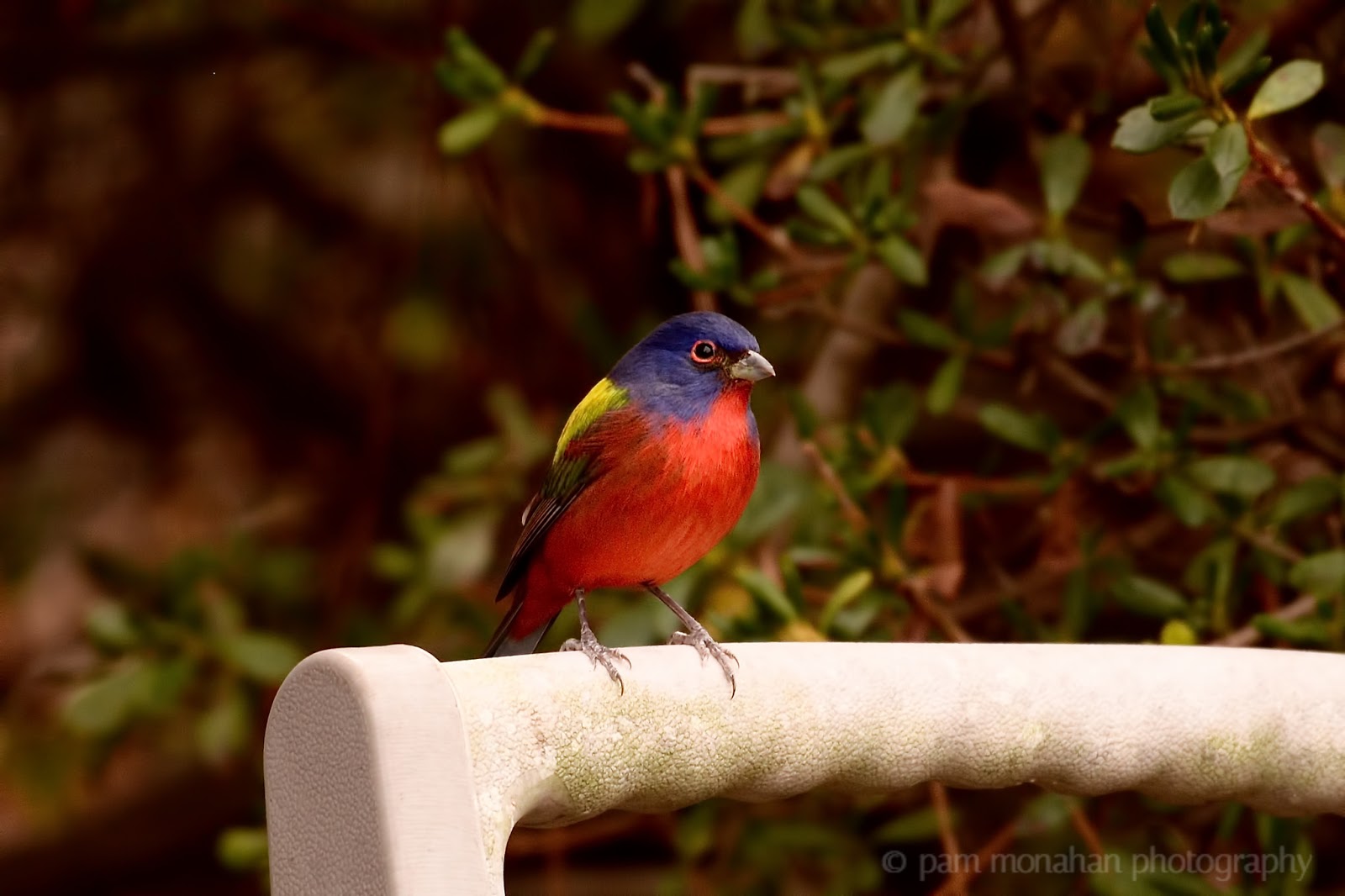
The Painted Bunting - A Trophy Bird
I am a trophy hunter. Although my weapon is not a gun, it is a sophisticated digital camera with a long, sharp, powerful lens. I don’t care for the word “hunt,” but that is what I am doing, as I patiently stalk birds or animals or sit for hours awaiting their appearance. I actually own a hunting blind but generally I use my Honda Pilot for that purpose. I dress in hunter camo clothes, when I am in the field, purchased in the hunting/fishing section of local retailers.
The trophy I was after to begin the New Year of 2019 was a songbird; the beautiful Painted Bunting.
The male bunting wears a coat of many colors. Male Painted Buntings are so stunning that they have been called "nonpareils," which means “having no equal” in French. The female is a beauty also, one of the few bright green birds in the wild.
Despite the male’s brilliant plumage, Painted Buntings can be hard to find. Their range is more limited than those of other buntings. They are shy birds that prefer thickets and brushy cover. Painted Buntings are a bird of the South, breeding from coastal North Carolina to northern Florida. They migrate at night and usually spend the winter in Florida and the northern Caribbean. So, when they show up in Virginia during winter, it is most unusual but a very exciting event. Sightings are so rare that the locations are not always shared as local birders, bird enthusiasts, and bird photographers are known to flock to these locations just to catch a glimpse of or to photograph these rare visitors.
I did actually have the opportunity to photograph some Painted Buntings at a local residence in VA Beach in 2018. That location was confidentially shared with me and I was able to return there again this year. But, I also did some detective work and found a second local private residence where the buntings were visiting this winter. This visit turned out to be very special as I was able to share it with a good friend and neighbor. Plus, it turned out that I had previously met the property owner!
It was cold and breezy when my friend and I arrived in Chesapeake that first week of January. I was dressed in camo, of course. She needed an extra layer so I loaned her an extra jacket, camo, naturally! We looked the part of hunters; 2 silver haired ladies, one armed with binoculars and one with a big camera with a long lens! We sat down in a couple of porch chairs and waited for our “prey.”
It took over an hour in frigid temperatures but the magnificent bird suddenly appeared before us! Good thing we didn’t blink, or we would have missed it! We had about 25 seconds with it, then it vanished in the dense shrubs. We were cold but so happy! For we had been treated to the rare sight of the gorgeous Painted Bunting and I had a dozen photos to prove it: trophy shots? They may have been at the time, but now I just want to spread the great news that this special bird has chosen Hampton Roads to spend some time. And I thank these local caretakers of these amazing birds for allowing me and my friend the opportunity to spend just a few minutes with them.
The trophy I was after to begin the New Year of 2019 was a songbird; the beautiful Painted Bunting.
The male bunting wears a coat of many colors. Male Painted Buntings are so stunning that they have been called "nonpareils," which means “having no equal” in French. The female is a beauty also, one of the few bright green birds in the wild.
Despite the male’s brilliant plumage, Painted Buntings can be hard to find. Their range is more limited than those of other buntings. They are shy birds that prefer thickets and brushy cover. Painted Buntings are a bird of the South, breeding from coastal North Carolina to northern Florida. They migrate at night and usually spend the winter in Florida and the northern Caribbean. So, when they show up in Virginia during winter, it is most unusual but a very exciting event. Sightings are so rare that the locations are not always shared as local birders, bird enthusiasts, and bird photographers are known to flock to these locations just to catch a glimpse of or to photograph these rare visitors.
I did actually have the opportunity to photograph some Painted Buntings at a local residence in VA Beach in 2018. That location was confidentially shared with me and I was able to return there again this year. But, I also did some detective work and found a second local private residence where the buntings were visiting this winter. This visit turned out to be very special as I was able to share it with a good friend and neighbor. Plus, it turned out that I had previously met the property owner!
It was cold and breezy when my friend and I arrived in Chesapeake that first week of January. I was dressed in camo, of course. She needed an extra layer so I loaned her an extra jacket, camo, naturally! We looked the part of hunters; 2 silver haired ladies, one armed with binoculars and one with a big camera with a long lens! We sat down in a couple of porch chairs and waited for our “prey.”
It took over an hour in frigid temperatures but the magnificent bird suddenly appeared before us! Good thing we didn’t blink, or we would have missed it! We had about 25 seconds with it, then it vanished in the dense shrubs. We were cold but so happy! For we had been treated to the rare sight of the gorgeous Painted Bunting and I had a dozen photos to prove it: trophy shots? They may have been at the time, but now I just want to spread the great news that this special bird has chosen Hampton Roads to spend some time. And I thank these local caretakers of these amazing birds for allowing me and my friend the opportunity to spend just a few minutes with them.
Sunday, November 11, 2018
The Christmas Owl
I had to practically lay on the floor to see up into the chimney. It was very dark but I could hear the wind howling. Or was that the wind? “Quiet, please, “ I whispered. I heard it again. “There’s an animal in here,” I hissed.
“In the fireplace?” he asked, incredulously.
“I think it’s on a shelf thingy,” I answered. “Go get some crackers and peanut butter so we can get it to come down. We’ll catch it then get it out. It’s probably a squirrel.” I pulled the chain fireplace screen closed.
So, we set out the bait and tried to sleep. We must have drifted off when suddenly we heard a fluttering. I crept across to the fireplace with the flashlight and peeked in. Two huge eyes stared back at me. “It’s an owl!” I hooted.
“Oh geesh,” my husband replied.
We removed the window screens and opened all our bedroom windows. I carefully pulled back the fireplace screen and tried and missed the little owl with a towel. It flew erratically around our bedroom. It tried to land on the curtain rods and flew into the bedroom mirror. It fell onto my jewelry box. My husband tossed the towel and it settled over the owl. “What do we do now?” he asked.
“Take it to the window and let it go,” I replied.
“My God!” exclaimed my husband. “It weighs almost nothing.”
“Just be careful,” I said.
He gently removed the towel and the tiny owl flew silently into that dark Christmas morning. It was an Eastern Screech-Owl, a species that we had heard many times on our property and had in fact called it in close, on occasion.
But, this story doesn’t end there.
That Christmas night, after we had the kids in bed, we stepped outside on our deck. Just above us in a tree we heard the unmistakeable call of an Eastern Screech-Owl. It was calling to thank us or perhaps to say, “Merry Christmas to and to all a good night!”
Note: The Eastern Screech-Owl pictured is not the same owl featured in this story. This is “Lola,” an educational ambassador at First Landing State Park.
Wednesday, October 10, 2018
The Belted Kingfisher
Locals to this area have probably already heard this bird, just didn’t know what it was. It emits a piecing “rattle” call as it patrols over lakes and ponds. It is also one of the few bird species where the female has more attractive coloring than the male. The Belted Kingfisher pictured here is a female, who sports a blue belt (as does the male) across the chest, but also a bright chestnut band. She’s a beauty!
Belted Kingfishers are stocky, large-headed birds with a shaggy crest on the top and back of the head and a straight, thick, pointed bill. Their legs are short and their tails are medium length and square-tipped. They are about the size of a Robin.
The Belted Kingfisher nests in burrows along earthen banks. They generally choose a bank near water, but may use a ditch, road cut, landfill, sand pit, or gravel pit far from water. A pair may select a nest site during courtship, usually high in the bank where floodwaters are unlikely to reach. The male probes the bank with his bill, flying back and forth to the female, who calls continuously from a nearby perch.The male and the female take turns digging the burrow, with males spending about twice as much time digging as females. They can have 1 or 2 broods a nesting season.
The Belted Kingfisher feeds almost entirely on aquatic prey, diving to catch fish and crayfish with its heavy, straight bill. I’ve seen it catch fish hovering on the fly but also dropping down from a perched location. When it spots a fish or crayfish near the surface, it takes flight, dives with closed eyes, and grabs the prey in its bill with a pincer motion. Returning with its prize, it pounds the prey against the perch before swallowing it head first. GULP!
Compared to other fish-eating birds, Belted Kingfishers seem to be relatively unaffected by environmental contaminants, possibly because their small prey accumulates only low levels of toxins. Kingfisher populations are limited by the number of earthen banks available for nesting, and some populations have grown and spread thanks to human-made sand and gravel pits. They are sensitive to disturbance, and may abandon territories if people begin frequenting the area.
So, the next time you hear that unmistakable rattle and maybe see a flash of blue; it’s a Belted Kingfisher!
Belted Kingfishers are stocky, large-headed birds with a shaggy crest on the top and back of the head and a straight, thick, pointed bill. Their legs are short and their tails are medium length and square-tipped. They are about the size of a Robin.
The Belted Kingfisher nests in burrows along earthen banks. They generally choose a bank near water, but may use a ditch, road cut, landfill, sand pit, or gravel pit far from water. A pair may select a nest site during courtship, usually high in the bank where floodwaters are unlikely to reach. The male probes the bank with his bill, flying back and forth to the female, who calls continuously from a nearby perch.The male and the female take turns digging the burrow, with males spending about twice as much time digging as females. They can have 1 or 2 broods a nesting season.
The Belted Kingfisher feeds almost entirely on aquatic prey, diving to catch fish and crayfish with its heavy, straight bill. I’ve seen it catch fish hovering on the fly but also dropping down from a perched location. When it spots a fish or crayfish near the surface, it takes flight, dives with closed eyes, and grabs the prey in its bill with a pincer motion. Returning with its prize, it pounds the prey against the perch before swallowing it head first. GULP!
Compared to other fish-eating birds, Belted Kingfishers seem to be relatively unaffected by environmental contaminants, possibly because their small prey accumulates only low levels of toxins. Kingfisher populations are limited by the number of earthen banks available for nesting, and some populations have grown and spread thanks to human-made sand and gravel pits. They are sensitive to disturbance, and may abandon territories if people begin frequenting the area.
So, the next time you hear that unmistakable rattle and maybe see a flash of blue; it’s a Belted Kingfisher!
Subscribe to:
Posts (Atom)